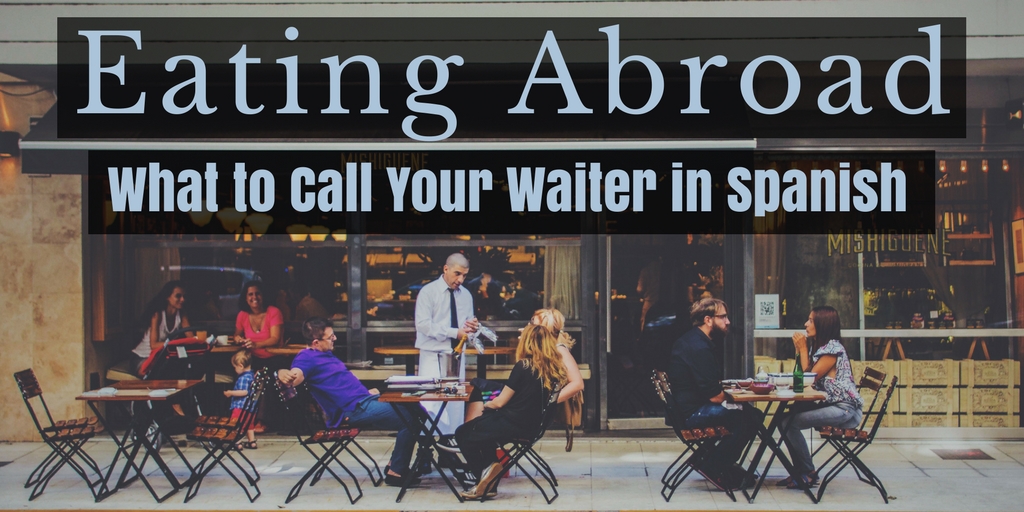
How to say waiter in Spanish
This really shouldn’t be a complicated question. It definitely shouldn’t be an entire blog post, right? You should be able to find out how to say waiter in Spanish like you can translate dog or cloud. I mean, you can, you just might be wrong.
You see, Spanish has a long, long history of taking over other countries and moving into them and completely disrupting their cultures. There was a point in time where the Spanish kingdom was the largest in the world - Spanish is still the second most widely-spoken language in the world, beaten out only by Chinese.
That being said, different words have different meanings whether you’re in Spain or Argentina or Mexico or any other Spanish-speaking country. The Spanish language has evolved into so many different animals that you sometimes need to prepare for different situations in different countries.
Camarero
The word ‘camarero’ (or the feminine ‘camarera’, but I want to keep this simple) comes from the word cámara, which translates to ‘bedchamber’ (well, it also translates to ‘camera’, but that’s beside the point). The Spanish mobility used to have a ‘camarero’, or bedchamber maid. These camareros would do things like make the beds and dress the nobles, the same sort of thing that a maid would do for the British Victorians.
These camareros would wait on the nobility. Translate that into our modern restaurant situations, and today the Spanish have employees to wait on them - bring the food, explain the menu, clean up after you, etc. It’s the same idea as the camareros reserved for the Spanish nobility, just brought into the present day.
Mesero
‘Mesero’ is our first not-so-common word. You might hear this word for waiter in Latin American countries like Mexico. While it’s not necessarily a “pure Spanish” word, the etymology of it is much more simple, if you can’t already tell from the word itself.
The Spanish word for table is ‘mesa’. Knowing that, it’s not too far of a stretch to come up with the term ‘mesero’. And, really, that’s all it comes down to!
You can also go straight for ‘joven’, the generic Spanish word for “young”. Adjectives like these (guapo, bonito, etc.) are generally used to refer to a person in any case, so this term is pretty simple, too. Just like you may call someone walking down the street “guapa”, it’s perfectly acceptable to get a Mexican waiter’s attention by calling them “joven”.
Mesonero
Like mesero hijacking the Spanish word for table, this other Latin American term for waiter hijacked another word, as well. ‘Mesonero’ derives from the word ‘mesón’, which refers to a large table. I’m sure you’ve seen TV shows or movies about rich elites who regularly dined on obscenely long tables, just to show off how much money they have, right? That is a mesón.
The mesonero of today refers more to a waiter working in a tavern, inn, or some other place that would entertain a significant amount of guests, usually enough to fill up a mesón. This is also a Venezuelan term, although if you know anything about languages, you know that they are living, breathing things that change regularly. You may hear this term referring to a waiter in other countries, as well.
Mozo
Next, we have ‘mozo’. This is another Latin American term commonly heard in Colombia, originally derived from the term for a page or apprentice. In Medieval Spain, where a young boy may be a page or apprentice, they would be referred to as a mozo, meaning “young man”. Just as one might call a waiter over by saying “young man” or “young woman”, a Colombian waiter can be called by saying mozo.
Garzón
Lastly, we have ‘garzón’. This term is used in Chile (where, by the way, you should definitely not use “mozo” unless you want to offend someone), and it means the same as above: “young man”. This one’s a great representation of cultural mixing, as it’s derived from the very same French term.
Julie Cao
I learned mostly Camarero for waiters, and I have no idea that it actually means chamber maid. The explanation and the originality you gave it here makes me easy to understand the meaning of these words. I am soon travel to South America and it amazes me how different Spanish-speaking countries speaks Spanish differently.
Jamie
I’m so glad I could help! It’s definitely interesting how people who speak the same language do it so differently.
Julie Cao
Yes it is very interesting. I am going soon to South America and wish I will go to Spain one day to see how different Latino Spanish is compared to Spanish spanish.
Ryan Biddulph
Hi Jamie,
Mesero makes the most sense to this Gringo 😉 When traveling through Spanish-speaking countries even though I am a little fluent I usually just wave politely and smile. Or maybe a “por favor” and wink and I receive service. Cool list. Thanks for sharing 🙂
Ryan
Jamie
I guess waving does get the job done, eh? 😉